
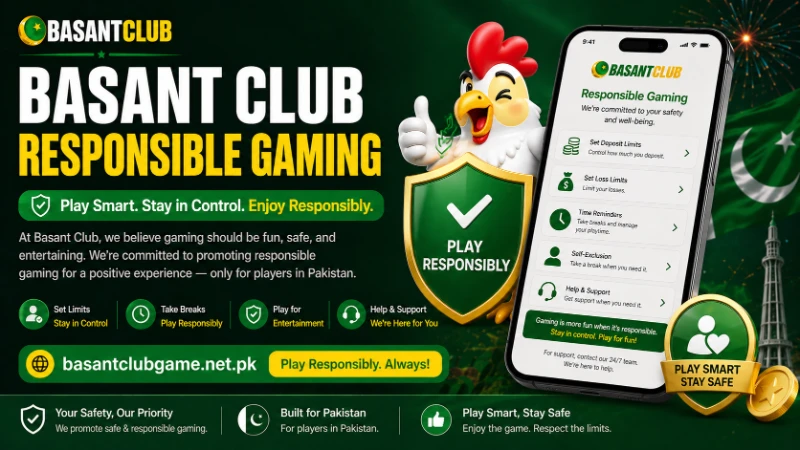
Basant Club Responsible Gaming
Millions of players in Pakistan log in every day to play casino games, color prediction, online slots, and bet on cricket. For most, it starts as a hobby. A way to unwind after work, maybe earn a little on the side.
That is completely fine until the fun quietly shifts. When the money stops feeling like entertainment money. When gambling moves from a recreational activity into financial stress, mental pressure, and problems at home.
That shift happens gradually. Most players do not see it coming. This page gives you practical strategies, honest information, and decision tools to keep your gambling behavior where it belongs under your control.
What Is Responsible Gaming?
Responsible gaming means you stay in charge, not the game.
It is about playing with a clear head, a set budget, and a time limit you stick to. You only put in money you can afford to lose, not rent, not savings, not grocery money. You decide your limits before you open the app, check your deposits and withdrawals regularly, take breaks during every session, and use platform controls like time-outs and self-exclusion before a small concern becomes a crisis. Keep your account secure with strong passwords, unique emails, and never share your OTPs.
Adults only, 18 and above. That line does not move.
Gambling & Islam: A Cultural Note
Pakistan is a majority-Muslim country. Islamic law is clear that gambling is prohibited, haram under Islamic law, and that religious boundaries carry real weight for most people here.
Basant Club covers gambling services that are internationally accessible. It does not push anyone toward something they are religiously bound or legally bound against. If you choose to engage, assess your own ethical boundaries, understand the legal implications in your province, and move forward only where it feels lawfully permissible and personally acceptable to you.
Faith and financial decisions are deeply personal in Pakistan. This page respects both.
Know the Risks
Every game carries real risk. Real money goes in. Real money can disappear, and doing that repeatedly has consequences beyond your wallet.
- Financial Loss: Deposits add up fast. Chasing losses after a bad session turns a manageable loss into a serious financial strain.
- Addiction and Dependency: Dependency builds quietly, more playing time, higher stakes, and harder to stop.
- Emotional Stress: Losing money produces anxiety. Hiding gambling from family produces guilt, anger, and depression, mental health risks that players rarely factor in.
- Relationship Issues: Overindulgence shows up at home. Social isolation follows when someone pulls away from family and friends to protect a habit.
- Criminal Behavior: In serious cases, debt from gambling pushes people toward illegal means, unethical financial decisions, and putting the family at risk.
Gambling has entertainment value. It also carries risk potential that every player deserves to know before they start.
Warning Signs of Problem Gambling
The signs of problem gambling creep in slowly, easy to explain away, easy to ignore.
Behavioral Indicators
You constantly think about gambling during work and family time. You find yourself lying about gambling activities, neglecting personal responsibilities, and borrowing money to gamble. The moment you fund gambling with borrowed money, the habit has crossed into compulsive behavior.
Financial Red Flags
Unexplained financial losses, selling personal assets, dipping into savings, accumulating gambling-related debt, these financial red flags point directly at a habit out of control. Debt accumulation does not stabilize without a behavior change.
Emotional and Social Warning Signs
Mood swings tied to gambling outcomes, anxiety between sessions, depression when losses pile up, difficulty controlling gambling impulses, social withdrawal, and emotional instability at this level affects everyone around you, not just you.
Guilt, irritability, secrecy, chasing losses if two or more feel close to home, these are addiction signs, not character flaws.
Tips for Responsible Gambling
The players who keep gambling enjoyable set their rules before the session, not during, not after a loss.
01. Set a Budget
Decide how much you can afford to lose before you start. Treat it as financial discipline, set a spending cap that fits your situation, and treat it as a hard stop.
02. Limit Your Time
Fix your session duration before you log in and set a timer. Time discipline matters as much as financial discipline. When it goes off, close the app.
03. Don’t Chase Losses
Chasing losses produces greater losses, not recovery. The money is gone. Close the app, come back another day with a clear head and a fresh budget.
04. Avoid Emotional Gambling
Playing when you are angry, sad, or depressed fast-tracks impulsive decisions. Substance influence lowers your judgment, a dangerous combination when real money is involved.
05. Take Frequent Breaks
Every 20 to 30 minutes, step away from the screen. Stand up, hydrate. Breaks interrupt the next-round reflex and keep mindful gambling alive throughout the session.
06. Use Responsible Tools
Deposit limits, wager limits, cooling-off periods, and self-exclusion options exist specifically for gambling management. Set them before your first session, not when you feel you need them.
Financial and Time Management Strategies
Money problems from gambling start with no plan sessions without a budget, and deposits without a ceiling.
- Start with a monthly entertainment cap fully separate from rent, bills, food, and savings.
- Use the envelope method: move your gaming budget into a separate wallet or prepaid card at the start of the month. When it runs out, you are done.
- Break the total into per-session limits of PKR 10,000 monthly, split into four weekly sessions of PKR 2,000 each, or PKR 500 daily.
- Track deposits, withdrawals, and time spent in a simple spreadsheet or notes app.
Setting Comprehensive Limits
A workable structure: daily deposit limit of PKR 2,500, weekly spending cap of PKR 10,000, session time restrictions of 90 minutes maximum, or 1 to 2 hours. Set these comprehensive limits inside the platform before your first session. A limit that feels uncomfortable to set is usually the right one.
Time Management and Session Plans
Unstructured sessions cost more than money. They cost time and decisions you would not have made with a clear head.
- Fix your plan duration at 30 to 45 minutes.
- Set a timer before you open the app, not after the first round.
- Use screen-time controls on Android or iOS as a backup.
- Take timed breaks every 20 to 30 minutes.
- Your stop rule covers both: timer goes off stop.
- Loss limit hit stop.
Structured play means the plan you made before the session overrides how you feel during it. That gap is where overspending lives.
Managing Triggers and Emotions
Most impulsive play comes from trigger windows: stress, arguments, boredom, late nights, and alcohol. These push players toward the app when their guard is down.
- When an urge hits, try urge surfing, acknowledge it, then delay 15 minutes.
- Fill that time with a competing behavior: a walk, push-ups, a call to a friend, or a household task.
- Most urges fade when time and distance are added.
- Re-assess after the delay. If emotional triggers run too deep for a 15-minute delay to handle, speaking to a counselor is the next honest step.
Understanding Risk: RTP, Variance, and House Edge
- RTP (Return to Player) is a long-term statistical average, not a promise for tonight’s session. An RTP of 95% does not mean you recover 95% every time you play.
- Variance tells you how bumpy the ride gets. High volatility means long dry spells and occasional big hits; it demands stronger discipline from the player.
- House edge is the percentage the operator keeps across all plays. RNG makes each round statistically independent a loss does not make the next round a win. Casino probability favors the operator over time. Carry that into every session.
Self-Assessment / Quick Self-Check
Go through this honestly. Answer based on how things actually are — not how you want them to be.
- Are you spending more than you planned?
- Do you gamble to escape personal problems?
- Have family or friends raised concerns?
- Do you hide your gambling activity by deleting browsing history, concealing play?
- Have you missed work, family time, or sleep because of a session?
- Do you deposit again quickly to recover losses? Do you feel anxious or irritable when you cannot play?
One yes, pause before your next session. Two or more, the habit deserves real attention. Run this self-check monthly. Behavioral self-evaluation done honestly is one of the most practical tools for personal accountability.
Self-Exclusion and Platform Controls
- Deposit Limits caps daily, weekly, and monthly deposits automatically.
- Loss Limits stop sessions when losses hit your pre-set number.
- Wager Limits and Stake Caps control individual bet sizes.
- Session Time Limits and Reality Checks track time spent and send pop-ups mid-session.
- Time-Outs pause your account for 24 hours to several weeks.
- Immediate Self-Exclusion and Permanent Account Closure lock the account for longer, are not easily reversed, and are not a punishment.
The right moment to set account controls is before you need them. The second right moment is right now.
Age Verification and Underage Gambling Prevention
Gambling is for adults, 18 years and above, no exceptions.
How Basant Club Handles Age Compliance
Every account goes through government-issued ID verification and multi-stage age confirmation checks. Underage attempts trigger immediate account suspension. Zero tolerance means exactly that.
What Parents and Guardians Need to Do
Use child-safe software and device-level parental controls on every device your child uses. Do not share gambling devices with children. Check browser history periodically, not to spy, but to stay aware of what gambling content your child has encountered. Use device-level content filters to block gambling websites entirely. If a minor has already interacted with gambling services, speak with a counselor. Minor protection is a shared responsibility between the platform and the home.
Getting Help & Support Resources in Pakistan
Gambling addiction does not fix itself. Reaching out early changes the outcome.
National Pakistani Resources
- SehatYab Pakistan addiction counseling, psychiatric support, online therapy: sehatyab.com
- PAHCHAAN Rehab Center, Lahore & Karachi +92-300-2144666 | pahchaanrehab.com
- Willow Addiction & Mental Health Center, Islamabad — willowrehab.com
- Willing Ways Pakistan — willingways.org
- Sunny Trust Pakistan — behavioral addictions: sunnytrust.org
- Pakistan Rehabilitation Center — addiction recovery programs
Mental Health Helplines
- Mental Health Helpline: 1166
- Emergency Services: 15
- Umang Mental Health, Lahore: 042-111-786-264
International Support Organizations
- BeGambleAware — begambleaware.org
- Gamblers Anonymous — gamblersanonymous.org
- GamCare UK — gamcare.org.uk
Treatment Options in Pakistan
- Psychiatric Counseling addresses the mental health treatment side of addiction, emotional triggers, thought patterns, and where control breaks down.
- Behavioral Therapy identifies and replaces the specific thoughts and behaviors feeding the habit.
- Outpatient Support lets you attend structured counseling services while continuing your daily life.
- Inpatient Rehabilitation suits cases of severe financial damage or relationship breakdown. Addiction rehabilitation centers in Pakistan offer full residential recovery programs.
- Group Therapy Programs reduce the isolation that gambling feeds on.
- Online Counseling Services remove the distance barrier for players in regions where in-person access is limited.
The right treatment depends on how far the problem has developed. Professional support exists in Pakistan across multiple formats, at different levels of intensity.
Frequently Asked Questions (FAQs)
Conclusion
Gambling is not the problem. Losing control of it is. Your budget, your sessions, your bank account at month’s end, how your family feels about the time the app takes, these are the real measures. Responsible gambling means decisions made regularly, before the session, with honesty about where things actually stand.
If this page made you reflect positively. If something here made you uncomfortable, sit with it. That discomfort is your clearest signal. If you are past the point of adjusting alone, reach out. Financial stability, mental health, and the people you care about recover with the right support.
Play smart. Prioritize family over a session, faith over a bet, your well-being over the next round.